Fields of work

Normalization of relations/dialogue

NSI contributes to normalization of relations between Belgrade and Pristina

Beograd – Pristina; Photo: EPA / Valdrin Xhemaj

NSI facilitates open exchange on the Brussels dialogue and normalization process among opinion-makers from civil society from Kosovo and Serbia. Moreover, NSI provides evidence-based independent analyses and recommendations for decision-makers involved in the process.

Key Assumptions:

–   There is a need for fostering a regular in-depth dialogue between civil society actors engaged in the normalization of relations from both sides, so to be able to propose improvements to the Track I dialogue among the officials based on an in-depth understanding of internal political dynamics and sentiments on both sides and NSI is well-positioned to facilitate such dialogue.

–    NSI will represent and include diverse representatives of the Kosovo Serbs community in the dialogue between civil society actors from different sides, which will add important voices and perspectives to the process.

–   NSI is capable of delivering high quality analysis using the evidence collected through qualitative and quantitative research, and producing recommendations for which NSI is able to advocate with decision makers.

To see the projects we are implementing or have implemented in the area of Normalization of relations/Dialogue, see our Reference List.

Normalization of relations/dialogue

NSI contributes to normalization of relations between Belgrade and Pristina

Beograd – Pristina; Photo: EPA / Valdrin Xhemaj

NSI facilitates open exchange on the Brussels dialogue and normalization process among opinion-makers from civil society from Kosovo and Serbia. Moreover, NSI provides evidence-based independent analyses and recommendations for decision-makers involved in the process.

Key Assumptions:

–   There is a need for fostering a regular in-depth dialogue between civil society actors engaged in the normalization of relations from both sides, so to be able to propose improvements to the Track I dialogue among the officials based on an in-depth understanding of internal political dynamics and sentiments on both sides and NSI is well-positioned to facilitate such dialogue.

–    NSI will represent and include diverse representatives of the Kosovo Serbs community in the dialogue between civil society actors from different sides, which will add important voices and perspectives to the process.

–   NSI is capable of delivering high quality analysis using the evidence collected through qualitative and quantitative research, and producing recommendations for which NSI is able to advocate with decision makers.

To see the projects we are implementing or have implemented in the area of Normalization of relations/Dialogue, see our Reference List.

Trustbuilding and Dealing with the Past

New Social Initiative supports different approaches to Trustbuilding and Dealing with the Past initiatives among communities

NSI intents to achieve several outcomes in order to meet this goal:

– NSI will be the channel of positive stories on inter-ethnic relations and reaching wider public by offering the innovative communication tools for visual and public affairs influencers (YouTubers, Instagramers, TikTokers, Journalists, Professionals and CSOs);

– NSI will be the convener and facilitator for structured exchange of attitudes and opinions, thus supporting trust building and collaboration among CSOs speaking on behalf of different ethnic groups in Kosovo;

– NSI will harvest and spread counter-narratives and positive stories, thus creating space for exchange and dialogue by partnering with media and digital outlets across Kosovo.

Key Assumptions:

–   New innovative solutions for trust building will resonate better with citizens, especially youth, and the positive frame of the inter-ethnic relations could disrupt diminish the strength and malign influence of the negative narratives they were socialized in;

Photo: Emerging Europej

–  “Pockets of Freedom” or forums, which remove the publicity constraints, will strengthen the bonds between CSOs from different communities, thus increasing the trust between them and allowing them to establish stronger coalitions on crucial societal topics, especially those related to the inclusion of the non-majority communities;

–  Engaging different audiences with opposite narratives on the same topic will soften the rooted stereotypes about the “other” communities and address the grievances from the past, and will fertilize the ground for trust building.

To see the projects we are implementing or have implemented in the area of DwP/trust-building, see our Reference List.

Trustbuilding and Dealing with the Past

New Social Initiative supports different approaches to Trustbuilding and Dealing with the Past initiatives among communities

Photo: Emerging Europej

NSI intents to achieve several outcomes in order to meet this goal:

– NSI will be the channel of positive stories on inter-ethnic relations and reaching wider public by offering the innovative communication tools for visual and public affairs influencers (YouTubers, Instagramers, TikTokers, Journalists, Professionals and CSOs);

– NSI will be the convener and facilitator for structured exchange of attitudes and opinions, thus supporting trust building and collaboration among CSOs speaking on behalf of different ethnic groups in Kosovo;

– NSI will harvest and spread counter-narratives and positive stories, thus creating space for exchange and dialogue by partnering with media and digital outlets across Kosovo.

Key Assumptions:

–   New innovative solutions for trust building will resonate better with citizens, especially youth, and the positive frame of the inter-ethnic relations could disrupt diminish the strength and malign influence of the negative narratives they were socialized in;

–  “Pockets of Freedom” or forums, which remove the publicity constraints, will strengthen the bonds between CSOs from different communities, thus increasing the trust between them and allowing them to establish stronger coalitions on crucial societal topics, especially those related to the inclusion of the non-majority communities;

–  Engaging different audiences with opposite narratives on the same topic will soften the rooted stereotypes about the “other” communities and address the grievances from the past, and will fertilize the ground for trust building.

To see the projects we are implementing or have implemented in the area of DwP/trust-building, see our Reference List.

Citizen participation

NSI is working on increasing non-majority participation in decision making processes for the purpose of getting better services and making institutions more accountable

Source: NSI photo archive

NSI works to achieve this goal on both supply and demand side of the citizen participation: 1) on the demand side, the outcomes of our engagement are the benefits that citizens have by utilizing the mechanisms of citizens’ participation, and 2) the creation of low profile community spaces which will support resonant voices; 3) on the supply side, the outcomes of our activities will be established and improved participation mechanisms in the institutions (in mostly Kosovo Serb majority municipalities).

Key Assumptions:

–    The increased demand for the better services will boost the efficiency of the institutions and increase their accountability;

–    Resonant voices are reluctant to speak out because of the non-pluralistic nature of the political arena of the Kosovo Serb community, but their participation in closed group discussions will encourage them to speak up in the future and preserve social capital required for any collective action;

–   Kosovo Serb majority municipalities will be open for cooperation on non-controversial issues, and will accept the citizen participation mechanisms.

To see the projects we are implementing or have implemented in the area of Citizen Participation, see our Reference List.

Citizen participation

NSI is working on increasing non-majority participation in decision making processes for the purpose of getting better services and making institutions more accountable

Source: NSI photo archive

NSI works to achieve this goal on both supply and demand side of the citizen participation: 1) on the demand side, the outcomes of our engagement are the benefits that citizens have by utilizing the mechanisms of citizens’ participation, and 2) the creation of low profile community spaces which will support resonant voices; 3) on the supply side, the outcomes of our activities will be established and improved participation mechanisms in the institutions (in mostly Kosovo Serb majority municipalities).

Key Assumptions:

–    The increased demand for the better services will boost the efficiency of the institutions and increase their accountability;

–    Resonant voices are reluctant to speak out because of the non-pluralistic nature of the political arena of the Kosovo Serb community, but their participation in closed group discussions will encourage them to speak up in the future and preserve social capital required for any collective action;

–   Kosovo Serb majority municipalities will be open for cooperation on non-controversial issues, and will accept the citizen participation mechanisms.

To see the projects we are implementing or have implemented in the area of Citizen Participation, see our Reference List.

Trade barriers are among the most common instruments of economic protectionism, but in politically unstable environments they become tools of political pressure. In Kosovo, this phenomenon is evident in the measures that local authorities in Pristina have introduced against goods from central Serbia. From the 100% tariffs imposed at the end of 2018 to the complete import ban in 2023, trade has been used as an instru- ment of political signaling rather than a neutral channel of economic exchange.1

The key problem lies in the fact that the measures directly affected the Serbian com- munity in Kosovo, which depends on a stable inflow of basic foodstuffs, medicines, and consumables. In practice, disruptions in supply chains have caused shortages, rising prices, and uncertainty in public services such as pharmacies and health cen- ters. Small shops, which form the backbone of the local economy, have faced clo- sure due to increased costs and uncertainty. These consequences are not short-term; rather, they create sustained pressure on the economic and social survival of the Ser- bian community.

This concerns thousands of citizens whose everyday lives depend on the availability of goods. If the problem is not resolved, there is a risk of irreversible consequences: the permanent loss of local trading networks, a deterioration in health due to shortag- es of medicines, and a heightened sense of isolation and insecurity. In the long term, this could weaken social cohesion and trust in any institutional processes.

The problem also goes beyond the local level. It encompasses the broader framework of regional integration (CEFTA, European processes), as well as trust in international actors mandated to oversee the implementation of agreements. If trade continues to be used as an instrument of politics, this undermines regional stability and every effort toward the normalization of relations.

This paper proceeds from the standpoint that trade must not be a means of politi- cal blackmail. It focuses on analyzing the mechanisms of the politicization of trade, identifying its economic, social, and political consequences, and formulating feasible recommendations that can provide a minimum of predictability and security for the Serbian community in Kosovo.


Lake Gazivode stands as one of the most critical yet contested resources in the West- ern Balkans. Supplying water, electricity, and ecological stability to communities in both Kosovo and Serbia, it embodies overlapping technical, political, and security dimen- sions. This paper examines the Gazivode problem as a convergence of political dead- lock, institutional ambiguity, infrastructural vulnerability, ecological fragility, and social dependence. Building on analyses by multiple sources the study maps the multi-layered challenges and evaluates possible pathways for sustainable management. Proposed solutions include short-term technical modernization under the supervision of neutral third parties, joint monitoring mechanisms that avoid the recognition trap, ecological cooperation through international platforms, scenario planning for crisis situations, and long-term, but currently aspirational, institutionalization. The paper argues that while no single solution is sufficient, combining technical improvements, ecological adaptation, and incremental confidence-building offers the best chance of transforming Gazivode from a potential flashpoint into a stabilizing resource.

This policy brief addresses a critical research question: Why is there a significant dis- parity in the participation and success rates of young Kosovo Serbs compared to their Kosovo Albanian counterparts in government-sponsored employment programs facil- itated by the Republic of Kosovo’s Employment Agency? This question is paramount for Kosovo’s social cohesion, economic stability, and the long-term integration of all its communities. As the government rolls out large-scale initiatives like ”Superpuna,” a wage-subsidy scheme for youth, and ”Qeveria për Familjet,” designed to support fam- ilies with no employed members, ensuring equitable access and outcomes for all cit- izens is not just a matter of policy effectiveness but a cornerstone of building a truly multi-ethnic and democratic state.

The issue directly affects the economic prospects and social mobility of young Serbs, a community crucial to Kosovo’s future. Failure to integrate this demographic into the formal labor market risks deepening inter-ethnic divides, fostering economic disenfran- chisement, and potentially fueling outward migration. For the government and its inter- national partners, this disparity represents a significant challenge to the stated goals of inclusive development and good governance. While existing reports have addressed youth unemployment in general,this brief focuses specifically on the structural and state-level barriers that exclude young Serbs from public programs. It argues that the lower participation and success rates among young Serbs are not arbitrary but are the result of systemic barriers. These include a lack of targeted, linguistically appropriate outreach, inequitable access to vocational training programs, and a lower level of trust in public institutions. Addressing these structural issues is essential for unlocking the full economic potential of all of Kosovo’s youth and ensuring that government employ- ment schemes achieve their intended universal impact.

The relationship between Belgrade and Pristina is still shaped by an unresolved past: the way events from 1998–1999 are remembered and interpreted is crucial for political trust and ev- eryday coexistence. Specific cases such as the events in the village of Račak (January 1999)— described by some as a massacre of civilians and by others as the outcome of an armed clash and political manipulation—remain points of deep disagreement, both in academic research and in public debates.1 Similarly, the 1999 NATO bombing holds a place of trauma and vio- lation of sovereignty in Serbian memory, while in the Albanian narrative it is often seen as a necessary protection of civilians under repression. These opposing interpretations are not confined to textbooks and archives—they spill into everyday speech and influence how young people perceive themselves, “the others,” and the possibility of cooperation.

Digital networks accelerate and amplify this dynamic. Young people in Serbia and in Koso- vo and Metohija today predominantly learn about the past through TikTok, Instagram, and YouTube, where algorithms encourage the virality of content that elicits a strong emotional response, thereby fueling echo chambers: young people are more likely to see confirmations of their existing beliefs than opposing arguments. 2 The experience of 2020 made this visible during the pandemic: conspiracy theories (from “5G networks spread the virus” to “interna- tional actors are using the crisis to subjugate the region”) spread faster than fact-checks, influencing attitudes and trust in institutions.3 This pattern—the rapid circulation of simplified, emotive, and often inaccurate narratives—maps onto topics from the 1990s as well.

Why is this a policy problem rather than merely a social phenomenon? Because digitally shaped narratives directly influence political behavior and society’s capacity for dialogue. If the online space is left to disinformation and toxic echo chambers, young people become carriers of prolonged divisions: willingness for encounter, joint projects, and trust in institu- tions decreases. Conversely, if investment is made in the digital space through media and digital literacy, moderated cross-border cooperation, and safety protocols for participants, that same space can become a training ground for learning multi-perspectivity, for co-creat- ing content, and for moving from “parallel truths” to work with facts. This policy paper starts precisely from that premise: how to empower young people—here understood as high-school students (15–18), university students (18–24), and young activists/creators (20–29)—to criti- cally distinguish facts from interpretations, and how to turn digital networks from amplifiers of polarization into infrastructure for dialogue and sustainable reconciliation.

It often sounds like a cliché to say that municipalities are the first door where citizens can address their problems, but when taken seriously, this helps us understand the centrality of local governance and the way municipalities operate. The placement of a parking lot can affect the daily routine of a parent waiting for their child after school; the bus schedule can reshape how a working day is organized; or a few more or less seconds at a traffic light can prove decisive in an emergency. These seemingly small decisions illustrate the importance of municipalities in shaping citizens’ everyday lives and their trust in institutions.

The same logic applies to interethnic coexistence: the way institutions function, how representative and present municipalities are in dialogue processes, how inclusive pol- icies are designed and implemented, and the quality of municipal programs all have a direct impact on building trust and fostering cooperation between communities.

In the context of normalization between Serbia and Kosovo, however, the presence of municipalities at the negotiating table has always been absent. Although municipalities are the frontline of service delivery and citizen trust, they remain excluded from the EU-facilitated dialogue, the main channel for normalization between the two countries. Agreements often touch directly on municipal competences, such as policing, civil reg- istries, and energy, yet municipalities are not visibly represented at the table.

The guiding question of this policy brief is therefore: To what extent have municipali- ties been present in the EU-facilitated dialogue, and what does their absence mean for implementation and legitimacy? This question is essential for advancing an inclusive and multiethnic society in Kosovo, as local actors stand at the frontline of interethnic relations. For citizens, municipal decisions are not merely technical; they shape daily life and perceptions of shared spaces and social security. For minority communities in particular, the functionality of these mechanisms is directly linked to fair representation and the protection of rights.

This policy brief argues that the decentralization of dialogue in Kosovo can serve as a genuine tool for integration only if the role and presence of municipalities are strength- ened and directly represented in discussions between the two states. The international community especially the European Union as the main facilitator of the dialogue should ensure greater municipal involvement in the negotiation process. Bringing municipalities closer to the drafting of agreements would not only improve their practicality and en- forceability on the ground but also strengthen the legitimacy of the dialogue by making it more responsive to citizens’ everyday needs.

With respect to methodology, this policy brief relies exclusively on document analysis as its research method. The analysis covers both primary and secondary sources in order to trace how municipalities have (or have not) been included in the EU-facilitated dia- logue and how their absence affects implementation.

• Primary sources include official agreements reached between Kosovo and Serbia from 2011 to 2023, as published by the European Union, the Government of Kosovo, and the Government of Serbia. In addition, EU press releases and statements from the European External Action Service (EEAS) were examined to capture the official framing of the dialogue process.

• Secondary sources consist of reports, policy papers, and analyses produced by civil society organizations and think tanks such as the Kosovar Centre for Security Studies (KCSS), Belgrade Centre for Security Policy CSP), the Balkans Policy Research Group (BPRG), Friedrich Ebert Stiftung (FES), and other relevant actors.

Together, these sources provide the basis for assessing both the formal role assigned to municipalities in dialogue-related agreements and the broader perceptions of their absence in shaping implementation and legitimacy on the ground.

The integration of minorities is a critical challenge in the normalization process between Kosovo and Serbia. This study examines the integration of Albanians in Serbia and Serbs in Kosovo, highlighting the implications for minority inclusion in post-conflict societies. Policies, laws, and political debates directly impact the daily lives of individuals. For Al- banians in Serbia, particularly in the Presheva/Preševo Valley, this often means limited political participation, restricted language rights, and economic challenges. For Serbs in Kosovo, especially those outside the north, the main concerns are personal security, trust in institutions, and cultural preservation.

Integration is not just an abstract concept; it is about dignity, belonging, and envisioning a future where communities can coexist peacefully. The treatment of minorities by these states is crucial for regional stability, democratic credibility, and the everyday realities of citizens seeking normalcy after prolonged conflict.

By comparing these two cases, this study aims to highlight both progress and remaining obstacles. It seeks to demonstrate how inclusive governance can foster coexistence and peace, offering valuable lessons for reconciliation in divided societies.

Methodologically, this report employs a combination of research methods to compre- hensively address the research question. The analytical method was utilized to review literature, legal frameworks, and reports related to minority integration. The compara- tive method served as the core approach, enabling a side-by-side analysis of Albanians in Serbia and Serbs in Kosovo. The descriptive/historical method was used to trace the development of minority rights since the Kosovo conflict, providing context for current challenges.

This report provides a detailed analysis of the evolving dynamics within the Kosovo Serb community, based on insights from five Policy Task Group sessions conducted between April and June 2025. These sessions brought together a diverse group of experts, including civil society representatives, local stakeholders, and policy analysts, to address pressing political, economic, security, institutional, and cultural challenges. Employing a qualitative research approach, the discussions captured nuanced perspectives and lived experiences to inform evidence-based policy development and advocacy strategies. Participants offered grounded, actionable insights into the risks and opportunities shaping interethnic relations, governance, and institutional trust, emphasizing the need for inclusive, community-driven solutions to foster integration and stability.

This report is part of the project “Dialogue, Solution, Future (DSF)”, implemented by New Social Initiative (NSI) in partnership with the Institute for Social Policy “Musine Kokalari”, with financial support from the Federal Foreign Office. The views and opinions expressed in this report are those of the participants and do not necessarily reflect the official position of the Federal Foreign Office or any other partner institution.

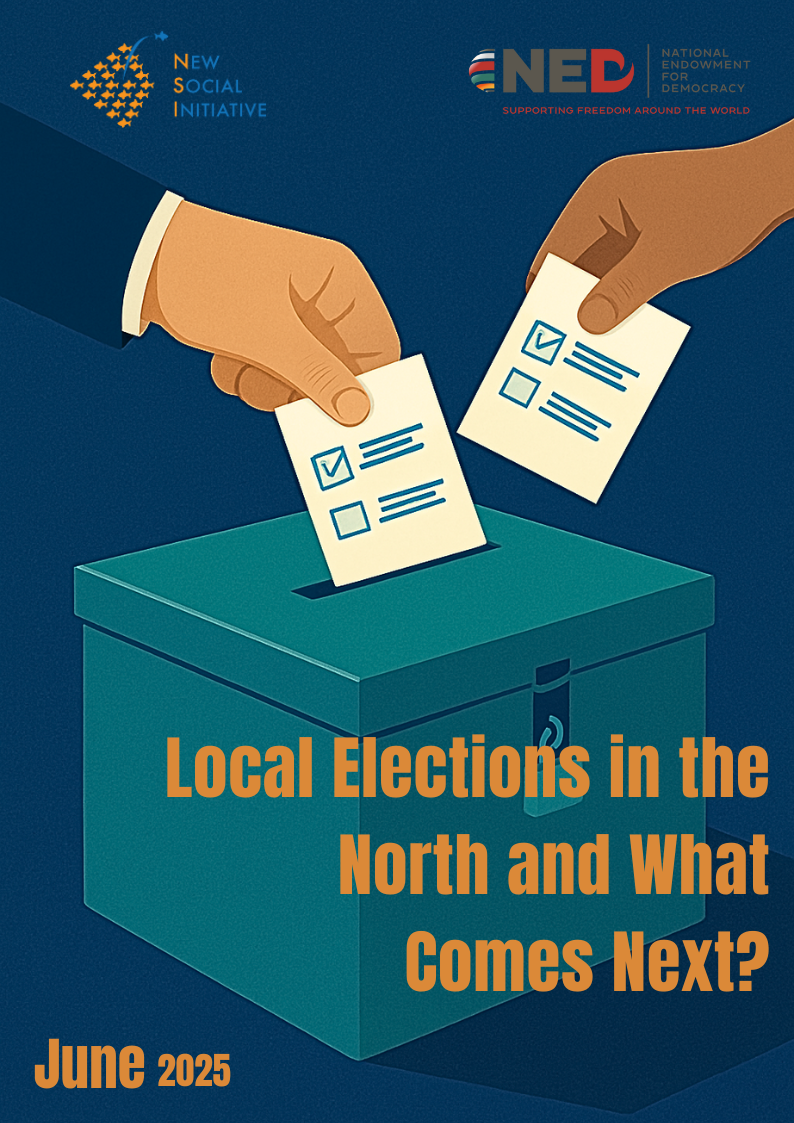
Kosovo is currently grappling with an institutional and political crisis, marked by growing uncertainty and fragility in its northern municipalities. As the region prepares for local elections, the atmosphere remains tense, with reintegration efforts hampered by persistent structural and human resource deficiencies. Legal ambiguity and administrative stagnation continue to characterize governance in the north, where public trust in institutions is steadily declining, fueled by perceptions of selective justice and uneven application of the rule of law.

This report is based on the discussions, which were held under the Chatham House Rule. This report was made possible with support from the National Endowment for Democracy (NED). The opinions and views of the report does not necessarily stat or reflect the views of NSI, NED, or of individual participants. It is simply a brief summary of the discussions.

This paper presents the attitudes, concerns, and recommendations shared by
residents who participated in the Inter-community Trust Tours (ITTs)—a series
of locally focused dialogue sessions conducted as part of the project
“Strengthening Community Relations in Kosovo.” The initiative, supported by
UNMIK and implemented by New Social Initiative, aims to foster
inter-community dialogue, empower civil society, and build trust through
inclusive, grassroots engagement